365 Days of Stories – Day 11: Cracking the Ride Request Search Algorithm – Finding Requests for a Ride
After solving how to find a ride for a ride request, I realized that finding ride requests for a planned ride was a much harder problem.
I started researching existing solutions and dived deep into algorithms and research papers to figure out:
🚀 How do we efficiently find points (pickup/drop locations) along a route?
Step 1: Researching Spatial Algorithms I read multiple research papers and algorithms related to spherical geometry and spatial search, including:
📖 Primitive operations in computational geometry 📖 Convex hull & Voronoi diagrams 📖 Shortest path algorithms for taxis 📖 Fast route planning algorithms
💡 It was overwhelming! There was a ton of information, but I stayed focused on one goal: ✔ How to find relevant points along a given route?
Anything unrelated, I discarded—I didn’t need a PhD in computational geometry, just a practical solution!
Step 2: The Polygon Approach – First Breakthrough Initially, I thought: 💡 If I could create a large polygon covering the entire route, I could find all ride requests within it.
So I tried: ✔ Creating a bounding box (polygon) around the entire route. ✔ Querying all ride requests within this polygon. ✔ Filtering requests that had the shortest pickup distance to the route.
🚧 Issue: If the ride route is 20-30 km long, the polygon would be too large, covering almost the entire city of Bangalore. 💡 This would return too many results, making the search inefficient.
Back to square one. I needed a better approach.
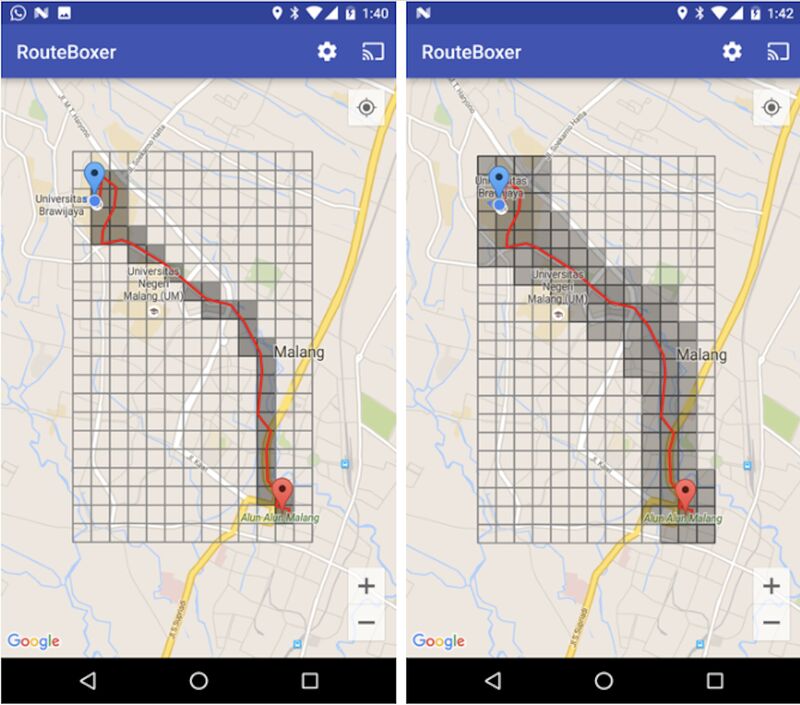
Step 3: Route Boxer – The Game-Changer Then I came across a concept called “Route Boxer” in one of the research papers.
🚀 Breakthrough Idea: ✔ Instead of creating one large polygon, create multiple small rectangles along the route. ✔ Each rectangle covers a small section of the route. ✔ The width of the rectangles aligns with the maximum pickup distance a ride requestor is willing to travel.
💡 Why was this better? ✅ Instead of one huge search area, I now had multiple small search areas. ✅ Each rectangle could be queried independently, improving accuracy. ✅ The search only returned relevant ride requests near the route.
🚀 Now, the search process became simple: 1️⃣ Create small rectangles along the entire route. 2️⃣ Query all ride requests within those rectangles. 3️⃣ Match pickup and drop points based on time and availability.
🚀 Hooray! I had cracked the ride request search algorithm.
Step 4: The Road to Implementation With ride search and request matching solved, I had: ✔ The design ✔ The core algorithm (No code) ✔ The technology decisions
But this wasn’t an overnight success—it took me exactly one month to complete (from 30th Sep to 29th Oct 2015).
💡 Next: The Journey of Coding Begins— Day 12.
How Important is Design and Core Algorithm Before Writing the First Line of Code?👇
hashtag#365DaysOfStories hashtag#Day11 hashtag#Entrepreneurship hashtag#StartupJourney hashtag#PersonalBrand hashtag#ElevateIdea